


Strength training after 40: the highest-leverage thing you can do
Of everything discussed in midlife health, resistance training has the strongest evidence and the widest effect. What the research supports, and how to start if you never have.
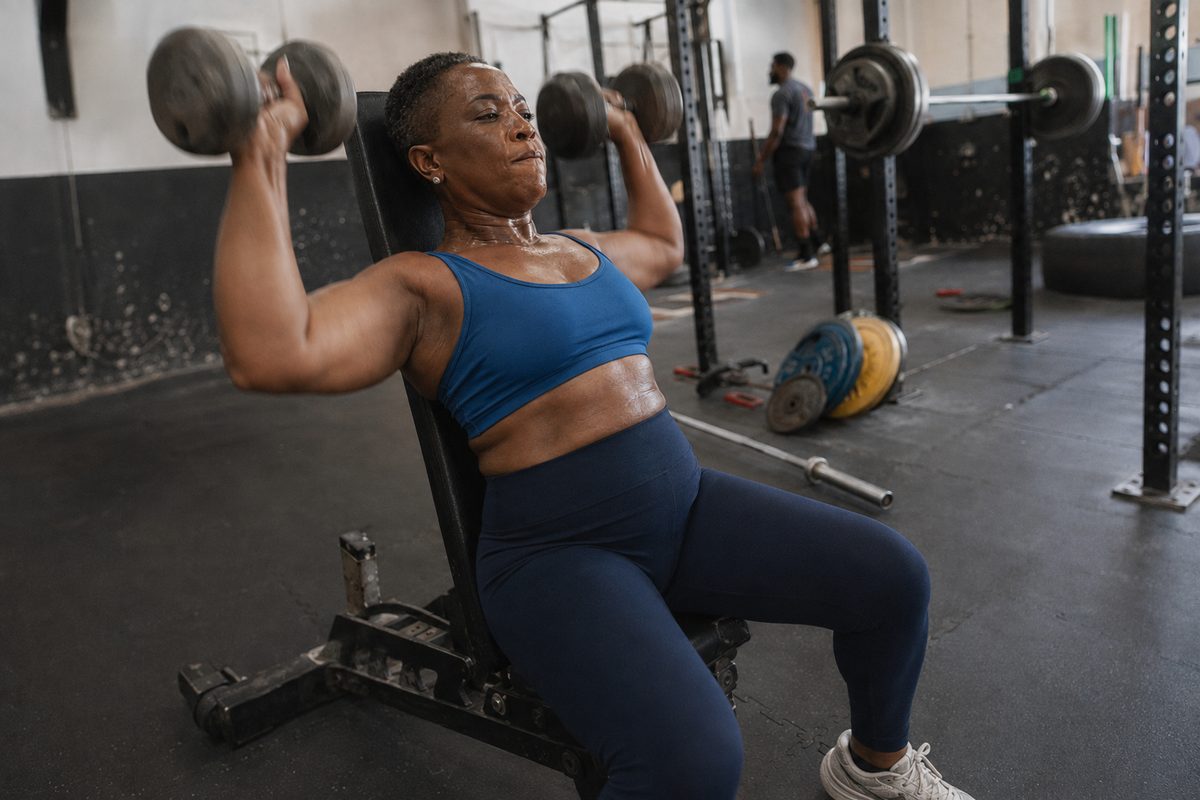
Progressive resistance training is the intervention with the strongest evidence base for women in midlife. It counteracts the age-related muscle loss that drives falling metabolic rate, it is one of the few things shown to maintain or improve bone density after menopause, and it improves insulin sensitivity, balance and mood. Two to three sessions a week is enough to produce meaningful change.
What to hold on to
- Muscle mass declines from around the fourth decade unless resistance training actively opposes it.
- Bone responds to load. Weight-bearing and resistance exercise are among the few non-pharmacological interventions with real evidence for bone density.
- Two to three sessions a week is sufficient. More is not obviously better and is harder to sustain.
- Progressive overload is the active ingredient: the load has to increase over time or adaptation stops.
- You will not become bulky. The hormonal environment of midlife makes that outcome extremely unlikely, and it is the most common reason women avoid the thing that would help them most.
Why this and not something else
We grade everything on this site by evidence, and most of what gets marketed to women in midlife grades weak. Resistance training does not. It is the one recommendation where the honest answer and the popular answer happen to coincide.
It addresses four separate problems at once. Muscle loss, which drives the metabolic change underneath midlife weight gain. Bone loss, which accelerates sharply in the years around the final period. Insulin sensitivity, which declines with both age and loss of muscle.
And balance and functional strength, which determine a great deal about the second half of life.
What the sessions actually look like
Two to three sessions a week, each covering the major movement patterns: a squat or leg press, a hinge such as a deadlift or hip thrust, a push such as a press-up or overhead press, a pull such as a row, and something for the core.
Sets in the range of two to four per exercise, repetitions somewhere between five and twelve depending on the load. The number that matters is not the specific protocol but whether the load is increasing over weeks and months.
Doing the same three-kilogram dumbbells for a year is exercise, and it is better than nothing, but it is not progressive resistance training and it will not produce the adaptations described above.
Starting from nothing
If you have never lifted, start with body weight and the movement patterns themselves. Sit-to-stand from a chair is a squat. A press-up against a kitchen counter is a press-up. Two weeks of learning the patterns before adding load is not wasted time.
A pair of adjustable dumbbells covers most of what is needed at home for a long time. A gym gives access to heavier loading, which eventually matters.
If you have osteoporosis, a previous fracture, uncontrolled blood pressure or a joint problem, get specific advice before starting, because certain loaded spinal flexion movements are inadvisable with low bone density. That is a reason to be coached, not a reason to avoid loading.
The bulky question
It is the most common objection and it is worth answering directly. Building substantial muscle mass requires a very large training volume, a calorie surplus, and a hormonal environment that midlife specifically does not provide.
What the overwhelming majority of women experience is that they get stronger, their body composition shifts, and nothing gets bigger.
The women who most fear this outcome are typically the ones losing muscle fastest.
Sources
Updated 27 August 2026
The questions to ask your doctor
A one-page guide built from what women told us their appointments were missing. Free, and we will not sell you anything in it.
One email to deliver it, then a weekly note you can leave whenever you like. We never sell your address, and we never attach it to anything you type into the check or the assistant.