


Why this and not more cardio
Two things happen to a woman’s body in this decade, and only one of them is menopausal.
Muscle mass declines steadily from around forty unless something is done to prevent it. That is ageing rather than menopause, it happens to men as well, and it is very largely preventable. Less muscle means a lower resting metabolic rate, which means the calorie deficit required to lose weight grows every year.
Separately, falling oestrogen shifts fat storage from the hips and thighs to the abdomen, and accelerates bone loss sharply in the years around the final period.
Sustained cardio and eating less will produce weight loss. A meaningful fraction of what comes off is muscle, which lowers the metabolic rate further, which makes the next attempt harder than the last. It is a treadmill in every sense.
Resistance training does the opposite. It signals the body to keep and build the tissue that is under threat, and it loads bone at exactly the moment bone needs loading. It is the only intervention that addresses both simultaneously.
None of this is an argument against walking. Walking is excellent for cardiovascular health, mood and glucose control. It simply does not do this particular job.
The six patterns
Everything worth doing fits into six categories. Cover them and you have covered the body.
- Squat. Goblet squat with a single dumbbell held at the chest. Sit down and stand up, under load.
- Hinge. Romanian deadlift. The single most valuable movement on this list for the posterior chain and for the spine.
- Push. Dumbbell bench press, or a press-up from the knees or a bench.
- Pull. Single-arm dumbbell row, or a band row anchored in a door.
- Carry. Farmer’s walk. Pick up something heavy in each hand and walk. It builds grip, core and posture, and it is the most directly useful thing on the list for real life.
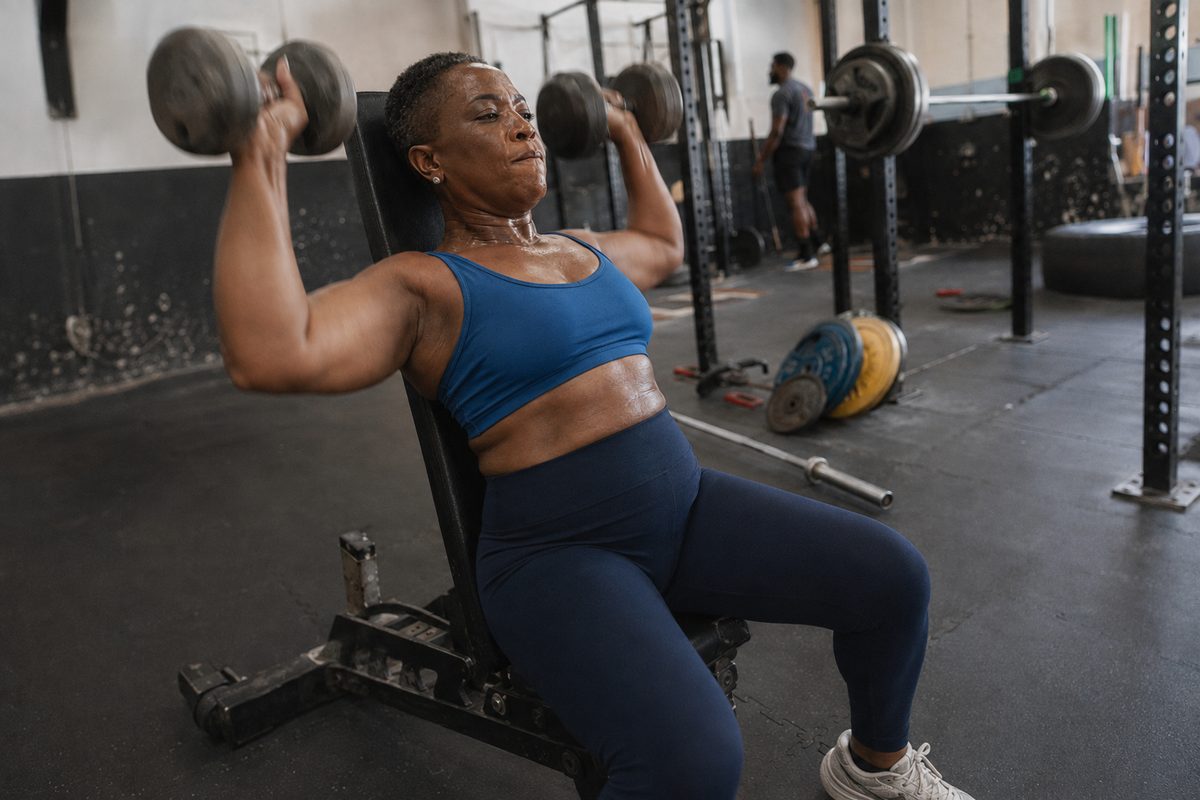
- Press. Overhead press, seated or standing. The shoulder movement most people lose first and miss most.
The twelve weeks
Weeks 1 to 4. Learning the movements. Two sessions a week. All six patterns each session. Two sets of eight to ten repetitions. Deliberately light: you should finish every set knowing you had four more in you. The goal in this block is that the movement becomes automatic, not that you are tired.
Weeks 5 to 8. Adding load. Three sessions a week if you can, two if you cannot. Three sets of eight. Now the last two repetitions should be genuinely difficult. Add weight whenever you complete all three sets at the top of the range with good form.
Weeks 9 to 12. Consolidating. Three sessions. Three or four sets of six to eight, heavier. By the end of week twelve most people who have never trained before are lifting close to double what they started with, and that is normal rather than exceptional.
Forty minutes a session. Rest ninety seconds between sets and do not apologise for it.
Progression without guessing
Write down the weight and the repetitions for every set of every session. This is not admin, it is the mechanism. Progressive overload means the load goes up over time, and you cannot increase something you are not measuring.
The simple rule: when you complete every prescribed set at the top of the repetition range with clean form, add the smallest available increment next session. For dumbbells that is usually one to two kilograms. That is slow, and slow compounds.
Joints
Some stiffness and some next-day soreness in the first fortnight is expected and settles. What is not expected is sharp pain, one-sided pain, pain that is worse the following week than it was the first, or any joint that swells.
Perimenopause genuinely does cause new joint aching, oestrogen is involved in joint and connective tissue, and load usually helps rather than hurts it. But new one-sided pain is a medical question before it is a training question, and a guide on a website is not the right thing to be reading about it.